
For many age-group athletes the half distance is where they spend their racing career. It is long enough that mistakes are punished, and short enough to take on seriously alongside a normal working life.
And it is something fundamentally different from the full distance — even though the numbers look like someone simply halved them.
Why half the course is not half the race
Over the full distance the job is to work as economically as possible for many hours. Start too hard there and you end up at the roadside. Over the half, the task is a different one: it is raced close to threshold, not below it.
That changes everything. The decisive quality is no longer how long you can keep going, but how high a pace you can just about hold for four to six hours — and whether you have anything left for the run.
In practice: over the full distance, starting too hard costs you the race. Over the half, starting too cautiously costs you the time. Misjudging either is the most common reason athletes sit on the same finishing time for years.
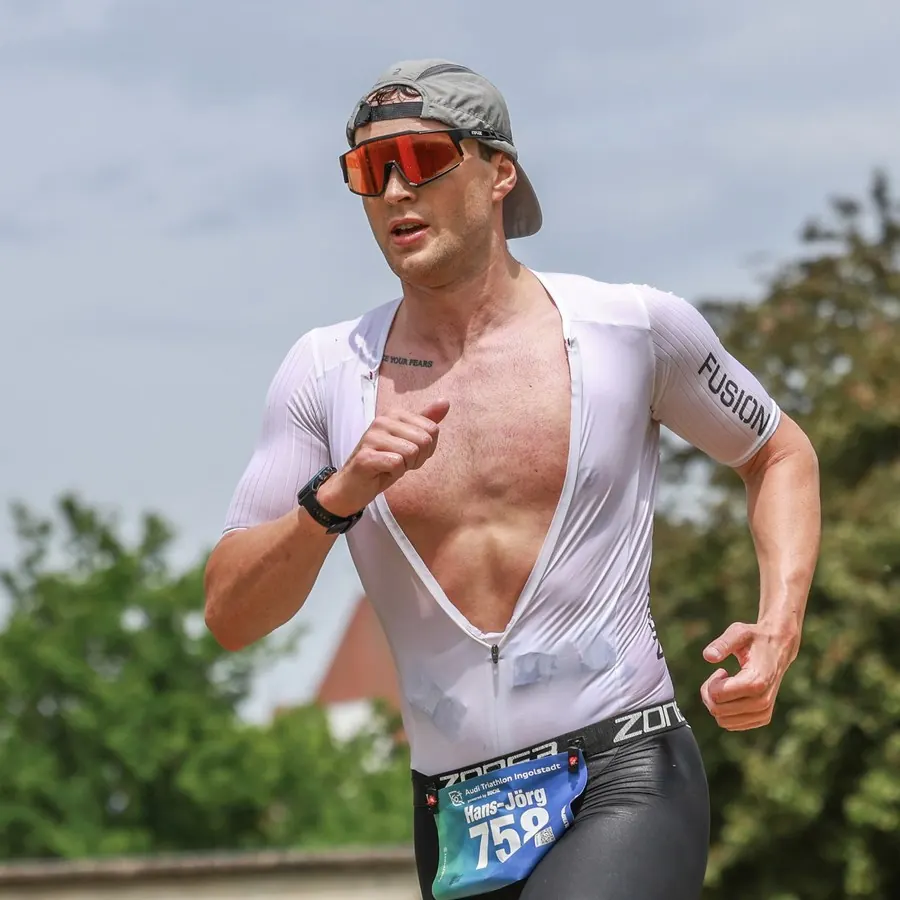
Your first half distance
Coming from sprint or Olympic distance, the step up is manageable — considerably more so than most people expect. The volume rises, but it does not blow up a normal week.
The themes in the first year are almost always the same:
- Actually being able to ride the 90 km. Not just getting through it, but still being able to run afterwards. That is the real test of this distance.
- A race pace you have measured, not guessed. Much of it is decided in the first thirty kilometres on the bike — where almost any pace still feels easy.
- Fuelling you have practised. Four to six hours is long enough for the stomach to matter, but short enough that many underestimate it.
- The transition from bike to run. The first two kilometres feel alien. That can be trained, and deliberately so.
Athletes who have taken exactly this route are under reviews — including someone who finished their first half distance in 2026.
Getting faster over the half
Once you know the distance, the work shifts. It is no longer about volume but about how your hours are distributed.
A review of training intensity distribution in endurance sport concludes that in controlled studies a polarised distribution — plenty of easy work, clearly separated hard efforts, little in between — produced better endurance markers in both well-trained and recreational participants than a distribution centred on threshold work.
That is the classic trap on this distance. Because the half is raced near threshold, many assume they should train there constantly. The result is training that is permanently tiring without achieving anything — and a personal best that has not moved in three years.
Typical starting points when progress stalls:
- Establish the threshold properly. Without reliable reference values, every pacing decision is guesswork.
- Find the weak link. The biggest reserve is often not in the discipline that feels worst.
- Translate bike power into run time. Gaining ten minutes on the bike and losing twelve on the run is not a gain.
- A race plan instead of instinct. Detailed race plans covering pacing and fuelling are part of the coaching from Premium upwards.
Briefly about me: 3:47 over the half, 8:34 over the full distance, and twelve overall podiums. Most of the mistakes that cost time over this distance, I have made myself.
Fuelling: shorter, but not irrelevant
Because the half is much shorter than a full distance, many treat fuelling as an afterthought. Over four to six hours of effort that does not hold up.
From a single carbohydrate source the body can use roughly 60 grams per hour; with a mix of different carbohydrates absorbed by different routes the recommendation is higher. In practice I work with roughly 60 to 90 grams per hour over this distance depending on race pace — and it is practised in training, not tried out on race day.
The higher amounts discussed for the full distance are usually neither necessary nor useful here. The detail is on the long-distance page.
Strength work: the underrated lever
A review of concurrent endurance and strength training concludes that running economy improves with accompanying strength or explosive-strength work; on the bike, heavy strength training in particular shows an effect.
Over the half that pays off twice: the closing half marathon is run on tired legs, and that is exactly where it separates those who hold form from those who fall apart. So strength and stability work is built into the week efficiently, not added on top as a fourth sport.
The distance that fits around a job
One honest argument for the half distance: it does not demand weekends where you disappear onto the bike for six hours. The longest sessions stay within a range that works alongside family and work — which is why many athletes race better here than over the full distance.
If your calendar is the real problem, read on here: long distance on limited time. Much of it applies to the half distance too, only with more room to manoeuvre.
How the coaching runs is on the triathlon coaching page; prices are on the pricing page.
Common questions about the half distance
How long does preparation take?
It depends on where you are coming from. Someone already finishing Olympic-distance races needs a different lead time from someone who has only just started swimming. An honest answer is only possible once I know where you stand — which is what the free intro call is for.
How many hours a week do I need?
There is no blanket figure here either. More important than the raw number of hours is that the time is reliably available and that each session has the right job to do. The plan is built around your week, not the other way round.
Should I do a half before attempting a full distance?
It is not compulsory, but it usually makes sense. A half distance is the best test of fuelling, equipment and race-day routine — under conditions where a mistake does not cost you the whole season.
Do I need a time-trial bike?
No. A road bike that works is entirely enough, and with well-fitted clip-on bars you get surprisingly far. If you do want to invest at some point, a power meter does more for you over this distance than a new frame — because it makes pacing plannable in the first place.
I have been stuck on the same time for years. Why?
In the vast majority of cases it is the distribution of intensity, not the volume. Training permanently in the middle zone accumulates fatigue without adaptation. That can be changed within a few weeks — and it is the most common adjustment I start with when working with experienced athletes.