
Most athletes who come to me with a full diary do not fail on willpower. They fail because their training plan assumes a life they do not lead: even weeks, reliable evenings, predictable weekends.
A plan built on that breaks in week two. What follows is the familiar pattern — catching up, overreaching, getting ill, stopping. Not because too little was trained, but because too much was trained at the wrong moment.
The real problem is unpredictability, not scarcity
There is a wide gap between "little time" and "unpredictable time". Ten fixed hours a week is straightforward to work with. Ten hours whose position in the week you do not know on Monday is not.
On top of that comes a load no watch records: a day of negotiations, a bad set of numbers, three nights of five hours' sleep. The body does not cleanly separate that from training load — the recovery still has to come from somewhere. That is what the life-load approach is about: work, sleep and private life are part of the plan rather than an interruption to it.
In practice that means a hard session is not cut because you do not feel like it, but because this week it would not pay off. That call is the hardest part of the job — and the reason coaching is worth more when time is short than when it is plentiful.

When hours are scarce, their distribution decides
On a limited time budget the key question is not how much you train but how the load is spread across the week. A review of training intensity distribution in endurance sport concludes that in controlled studies a polarised distribution — plenty of easy work, clearly separated hard efforts, little in between — produced better endurance markers in both well-trained and recreational participants than a distribution centred on threshold work.
That matters most for people short of time, because the most common mistake falls into exactly that gap: those who train rarely almost always train too hard. Every session carries a "this one has to count" feeling, and lands in the middle zone — tiring enough to cost recovery, too unspecific to drive adaptation.
How far volume can be replaced by intensity has been studied well — mostly outside long-distance sport. In one controlled trial, active but untrained participants reached similar metabolic adaptations after six weeks of short, very hard intervals as a comparison group doing classic endurance training, on roughly a third of the weekly training time. A review from the same group frames such programmes as a time-efficient route to better aerobic fitness and health.
What those studies do not say matters just as much: they ran over weeks rather than a long-distance season, and the endpoints were laboratory markers, not race times over eight hours. The long ride cannot be optimised away. If you want to cover the distance, you need time in the saddle. What can be optimised is everything around it: the short weekday sessions, their order, and the recovery in between.
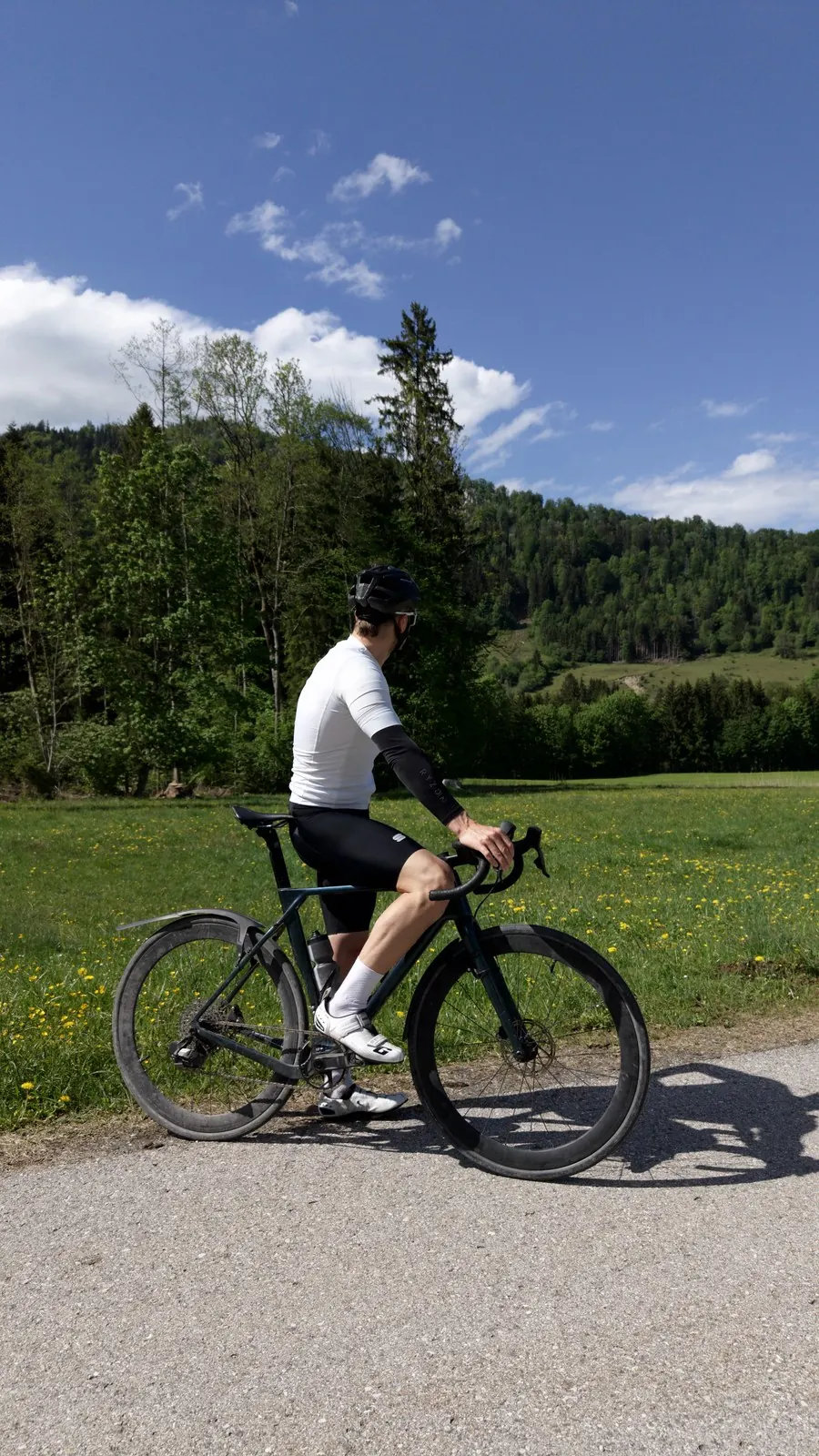
What a week built around commitments looks like
The plan is not written in January for the whole year; it runs alongside you week by week. In practice:
- The week starts with your calendar. Known commitments, travel and peak periods at work go in first; training is placed around them.
- A core that always happens. A small number of sessions that survive even the worst week. They hold the build-up together when everything else falls away.
- Moved, not made up later. If something drops out you send a short message and get an adjusted week — not an instruction to catch up.
- Long sessions sit where they are realistic. For most people that means weekends, for some early mornings. Both work when they are planned rather than improvised.
Plans run in MATS COACH, communication over WhatsApp, phone and video calls. How the planning itself is built is covered under training plans; how the coaching runs overall is on the triathlon coaching page.
Travel, hotels and time zones
Business travel is where most preparations quietly come apart. Not because nothing is possible on the road, but because nobody decided in advance what applies while you are away.
So travel weeks get rewritten in advance: sessions that work in a hotel or with a pair of running shoes, and clear priorities for the case where only one session out of three happens. Late flights, short nights and time zones are treated as what they are — load that belongs in the following week's planning.
Fuelling: the piece time-poor athletes underestimate most
Over the full distance the stomach decides at least as often as fitness does. The old rule of thumb — roughly 60 grams of carbohydrate per hour from a single source, around 90 from a mix — has been overtaken: in randomised trials with elite mountain runners, 120 grams per hour came out ahead, with lower muscle damage markers and better recovery the day after. In practice I work with 40 to 80 grams per hour in easy base training and 90 to around 140 in hard or long sessions, depending on what the session is for.
The part that matters for you: nobody tolerates those amounts from a standing start. Participants in those studies had spent months getting their gut used to it — and that takes the long sessions, the very ones that get cut first when time is short. Reducing volume therefore means planning fuelling more deliberately, not less. Here it lives in the training plan, not on a race-day checklist. The full version is on the long-distance page.
Strength work — especially when time is short
Strength training is the first thing to go when the diary tightens. The evidence argues against that: a review of concurrent endurance and strength training concludes that running economy improves with accompanying strength or explosive-strength work, while on the bike heavy strength training in particular shows an effect.
Economy means the same pace for less energy. That is precisely the currency when training hours are capped. So strength and stability work is built into the week efficiently rather than added on top as a fourth sport.
Why support counts for more when time is short
An athlete with twenty hours a week can absorb planning mistakes; the volume cushions them. At eight hours nothing cushions anything: one badly placed hard session costs not a session but half the week.
Athletes who have taken this route — including finishers with demanding jobs — are under reviews, in their own words.
This is the part of the work that resists a feature list: not the first plan, but the hundred corrections after it — and the willingness to tell you when this week has the wrong thing on it.
Who this page is not for
A coach does not replace training time. If your calendar cannot accommodate long sessions for months on end, the full distance is the wrong goal for this season — and I will say so in the intro call rather than sell you a package. Often the more honest answer is to move the goal by a year, or to go via the half distance first.
Common questions
How many hours a week do I need for the full distance?
There is no honest blanket figure, and any site quoting one is guessing. It depends on how many years of endurance training you have behind you, how well you swim and what result you want. More important than the number of hours is how reliably that time is available. In the intro call we look at your actual calendar — after that the question can be answered.
What happens if I lose two weeks entirely?
The plan gets rewritten. Two weeks off inside a multi-month build-up is not a disaster; trying to make them up in week three is. Phases like that are exactly why the planning runs week by week.
I travel a lot. Does the coaching work from abroad?
Yes, it runs entirely online. Plans, data reviews and communication go through MATS COACH, WhatsApp and video calls — location is irrelevant. Coaching is available in German or English.
How much of my own time does the coaching itself take?
Very little, by design. The plan is waiting in the app, your feedback takes a few sentences, and calls are scheduled and kept short. If something comes up in between, a message is enough.
Am I tied into a minimum term?
No. The packages run monthly. Details are on the pricing page and in the FAQ.
Do I need expensive equipment?
To start, a sports watch and a bike that works are enough. A power meter is the single most worthwhile investment over this distance because it makes pacing the bike leg reliable. Anything beyond that we discuss when it becomes relevant — buying expensive kit at the start is never necessary.